Islamic State Wilayat Halab Diwan al-Zakat wa al-Sadaqat
al-Ra’i Office No. Date: 6 Rajab 1437 AH
In the name of God, the Compassionate, the Merciful
Praise be to God the Lord of the Worlds and prayers and peace be upon the most noble of the prophets and those sent, our sayyid Muhammad, and all his family and companions.
Notification
The brothers registered with the al-Ra’i zakat office and have changed their residence address should see the office in the village of Tel Batal Sharqi so that their residency address can be updated.
And God is the One behind the intention.
Office for the zakat and sadaqat office in al-Ra’i and Akhtarin
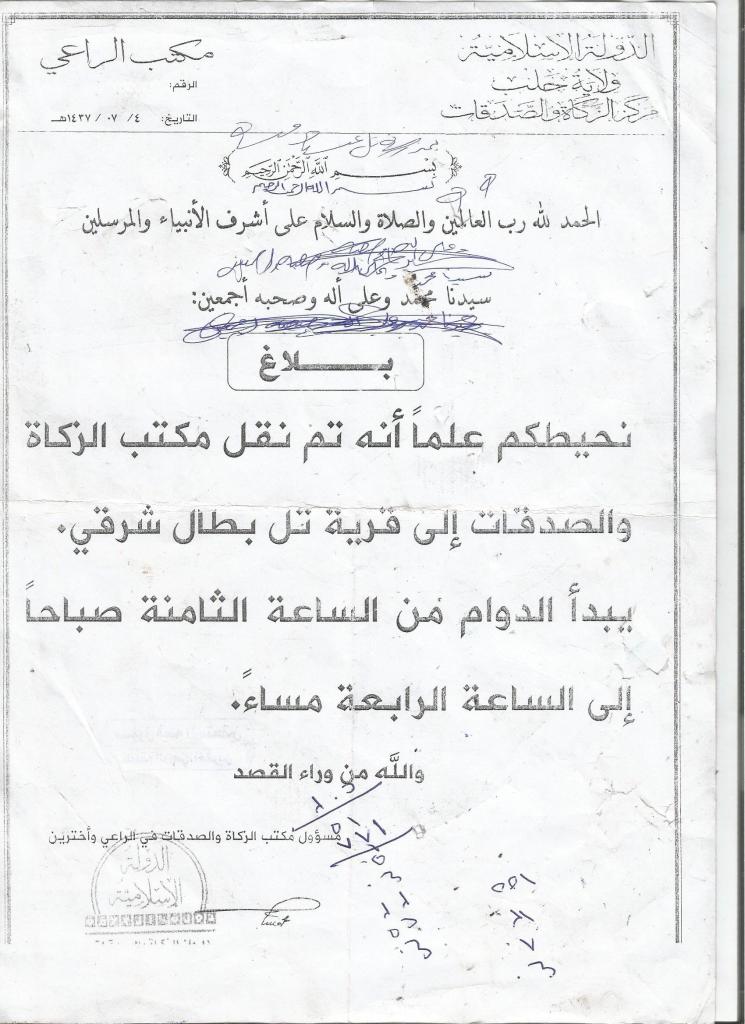
Islamic State Wilayat Halab Diwan al-Zakat wa al-Sadaqat
al-Ra’i Office No. Date: 4 Rajab 1437 AH
In the name of God, the Compassionate, the Merciful
Praise be to God the Lord of the Worlds and prayers and peace be upon the most noble of the prophets and those sent, our sayyid Muhammad, and all his family and companions.
Notification
We inform you that the zakat and sadaqat office has been transferred to the village of Tel Batal Sharqi. Office hours last from 8 a.m. to 4 p.m.
And God is the One behind the intention.
Office for the zakat and sadaqat office in al-Ra’i and Akhtarin
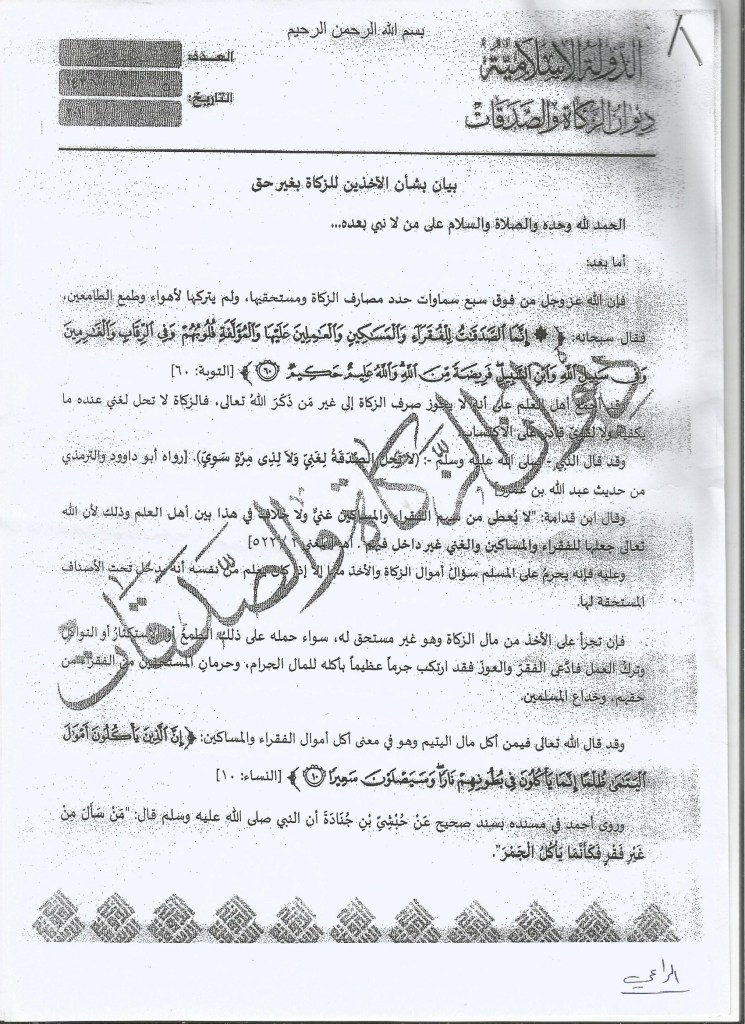
In the name of God, the Compassionate, the Merciful
Statement about those who unjustly take zakat
Praise be to God alone and prayers and peace be upon the one after whom there is no prophet. As for what follows:
From above the seven heavens, God- Almighty and Exalted is He- defined the disbursements of zakat and the people deserving zakat, and He did not leave zakat to the whims and ambitions of the greedy. For the Exalted said: “Charity is for the fuqara’, the masakin, those who work on the matters of charity, for those whose hearts are to be conciliated, for freeing slaves, those in debt, in the path of God, and for the wayfarer. It is a duty imposed by God, and God is wise and knowing” (al-Tawba 60).
The scholars have agreed that it is not allowed to disburse zakat to those who are not mentioned by God Almighty. So zakat is not permitted to a rich person who has sufficient means or to a strong person capable of making a living.
The Prophet (SAWS) said: “Charity is not permitted to a rich or strong person”- (narrated by Abu Dawud and al-Tirmidhi from a hadith of Abdullah bin ‘Amro).
Ibn Qudama said: “A rich person is not to be given from the shares of the fuqara’ and masakin, and there is no disagreement about this among scholars. For God Almighty has made zakat for the fuqara’ and masakin and the rich person is not part of those categories of people” (al-Mughni 2/522).
Therefore, it is forbidden for the Muslim to ask for zakat money and take from it unless he knows from himself that he comes under the categories of people entitled to it.
So if one not entitled to zakat money dares to take from it, whether driven to do so by greed, a desire for more, indifference or abandoning work, and then claims poverty and destitution, that person commits a great crime by consuming wealth forbidden to him, and depriving the entitled ones among the poor of their right, and deceiving the Muslims.
God Almighty has said about those who consume the orphan’s wealth, meaning the consumption of the wealth of the fuqara’ and masakin: “Those who consume the wealth of the orphan in an act of wrongdoing, eat fire in their bellies and will burn in the flames of hell” (al-Nisa’ 10).
Ahmad narrated in his Musnad in an authentic transmission on the authority of Hubshi in Junada: that the Prophet (SAWS) said: “Whoever asks [for zakat] without being poor, it is as though that person is eating fire.”
Muslim narrated on the authority of Abu Hurayra (may God be pleased with him): that the Messenger of God (SAWS) said: “Whoever asks people for their wealth in a bid to gain more is asking for fire, so let him seek less or more.”
“This means that he is punished with Hellfire and it is probably intended in the literal sense, and that what he takes becomes an ember by which he is burned just like the one who refuses to give zakat”- (Sharh al-Nawawi 7/131).
al-Bukhari narrated in the chapter entitled “The one who requests from people in a bid to acquire a lot of wealth” on the authority of Ibn Omar (may God be pleased with them both), that the Prophet (SAWS) said: “The man continues asking the people until he comes on the Day of Judgement and has no piece of flesh on his face.”
Part of the punishment of consuming forbidden wealth is that if one prays, one will not be heard. For Muslim narrated in his Sahih collection on the authority of Abu Hurayra (may God be pleased with him), that the Prophet (SAWS) mentioned the case of the man who travels for a long time and is dishevelled and dusty and raises his hands to heaven and says: ‘Oh Lord, oh Lord.’ But his food and drink come from prohibited things, and his clothing comes from what has been prohibited, and he has been fed with forbidden food. So how can his prayer be answered?
Part of the punishment also is the loss of one’s permissible wealth with one’s forbidden wealth, and that God opens the door of poverty on this person. Ahmad narrated in his Musnad on the authority of Abd al-Rahman bin ‘Awf: that the Messenger of God (SAWS) said: “Man does not open the door of asking for money without God opening the door of poverty upon him.”
So the one who consumes from zakat money without being entitled to it must repent to God (Almighty and Exalted is He), make do with what wealth God has granted him, and return the zakat money he has taken (or its value if he has spent it) to the party from whom he took the money, and be content with what God has provided him. The Messenger of God (SAWS) said: “Successful is the one who has accepted Islam, been provided sufficient sustinence, and has been made content by God with what has come to him”- (narrated by Muslim on the authority of Abdullah bin ‘Amro bin al-‘As). The one who is aware of this person’s state must restrain him, admonish him, and make him afraid of God. If this person repents, that is fine, but otherwise, one must refer said person’s situation to the relevant authority.
Thus, the Diwan al-Zakat wa al-Sadaqat issues a warning to all proven to be consuming zakat wealth while not being entitled to it and having used lying and deception to obtain it, and likewise all those enriched by God following a state of poverty and continuing to take zakat money from the Diwan, that they will come under the list of discretionary punishments put in place by the Diwan, including:
. Imposition of a discretionary punishment on all proven to have lied or concealed their wealth and sufficiency, whereby they must return the zakat money they have taken and a sum ten times its amount, unless they come in repentance before power is gained over them.
We also urge the Muslims to help us to perform this great obligation for which the eyes of those leading its implementation have remained awake for so long so that the zakat can reach those entitled to it, and we urge that the one who knows of a person of sufficient wealth and yet is consuming the wealth of the poor should hurry to inform us via contact with the nearest zakat office. This is an example of cooperation on the basis of piety and fear of God. The Almighty has said: “And cooperate on the basis of piety and fear of God, and do not cooperate on the basis of sin and enmity. And fear God, for God delivers severe punishment”- (al-Ma’ida 2).
And God is well aware of His servants.
Diwan al-Zakat wa al-Sadaqat The amir
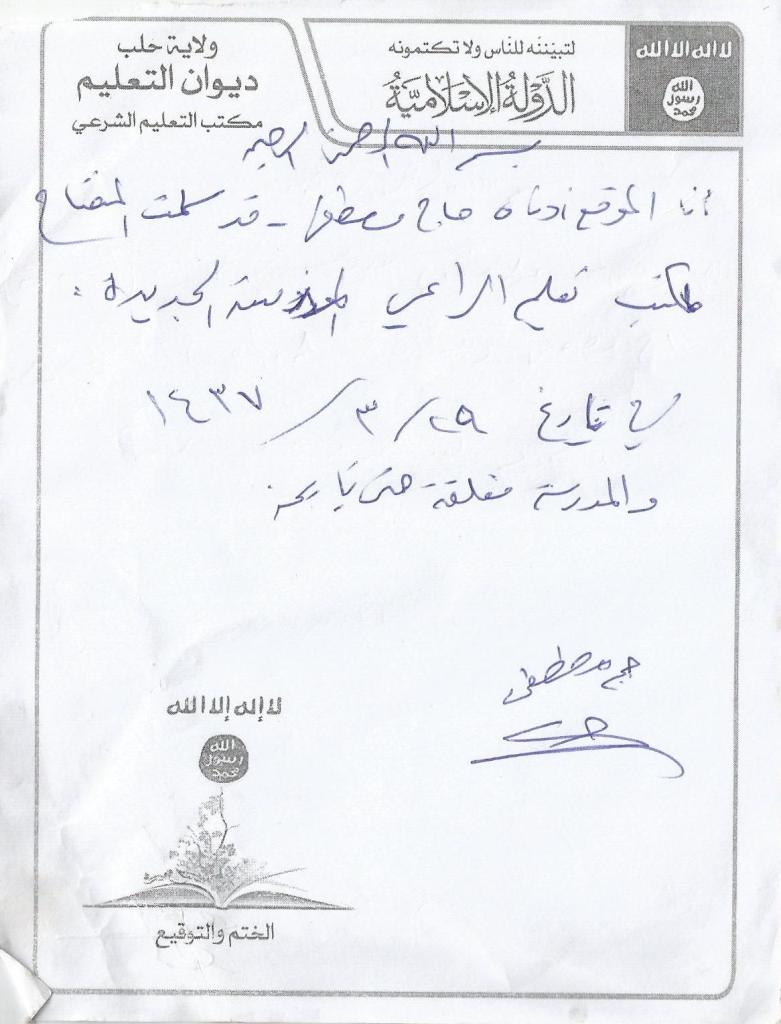
Islamic State Diwan al-Zakat wa al-Sadaqat The amir
In the name of God, the Compassionate, the Merciful
I- the signatory below- Hajj Mustafa have handed over the key to the al-Ra’i Education Office- the new school on date 29 Rabi’ al-Awal 1437 AH [10 January 2016 CE]. And the school has been closed until this date.
Hajj Mustafa
There is no deity but God Muhammad is the Messenger of God
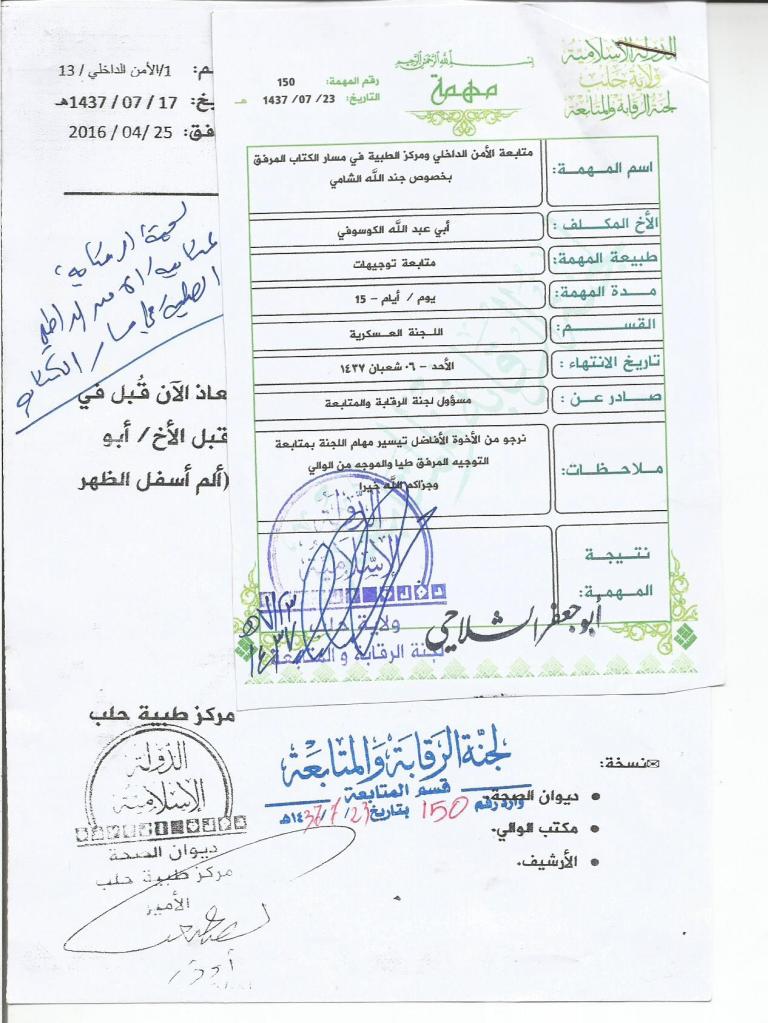
In the name of God, the Compassionate, the Merciful
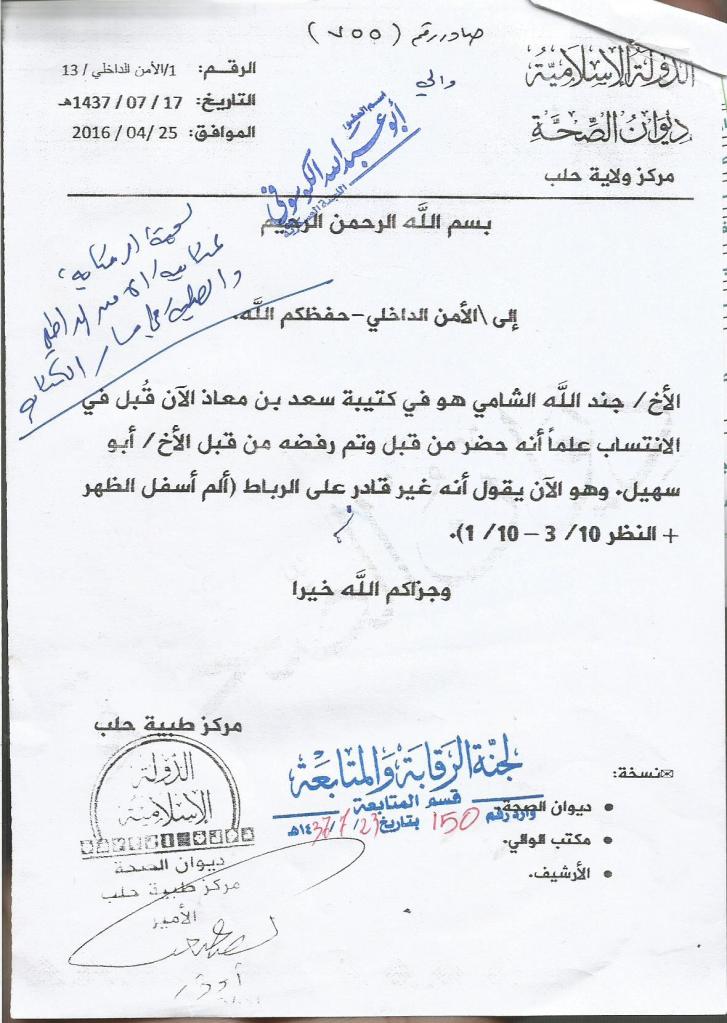
Islamic State Wilayat Halab Oversight and Tracking Committee
Assignment
Assignment no.: 150 Date: 23 Rajab 1437 AH
Assignment name: the internal security and health centre are to follow up on the issue of the attached letter regarding Jundallah al-Shami [see previous post for more]
Assigned brother: Abu Abdullah al-Kosovi Nature of mission: following up on directives Length of mission: 15 days Department: military committee Date of end: Sunday 6 Sha’aban 1437 [15 May 2016] Issued by: head of the oversight and tracking committee Notes: we ask the dear brothers to facilitate the committee’s missions in following up on the attached directive sent by the wali. May God reward you best. Assignment outcome:
Islamic State Wilayat Halab Oversight and Tracking Committee
No. 1/Internal Security/13 Date: 17 Rajab 1437 AH corresponding to 25 April 2016 CE
[Stamp]: Abu Abdullah al-Kosovi (military committee)
[In handwriting]: oversight and tracking committee/internal scurity and medical department on the issue [?] of the letter
In the name of God, the Compassionate, the Merciful
To: the internal security (may God protect you)
The brother Jundallah al-Shami is in the Sa’ad bin Mu’adh Battalion now. He was accepted for recruitment, though it should be noted that he came before and was rejected by the brother Abu Suhayl. Now he says that he is unable to perform ribat (pain in lower back and sight: 1/10-3/10).
May God reward you best.
Aleppo Medical Centre
Islamic State Diwan al-Siha Aleppo Medical Centre The amir
Oversight and Tracking Committee Tracking Department No. 150, date 21 Rajab 1437 AH [29 April 2016 CE]
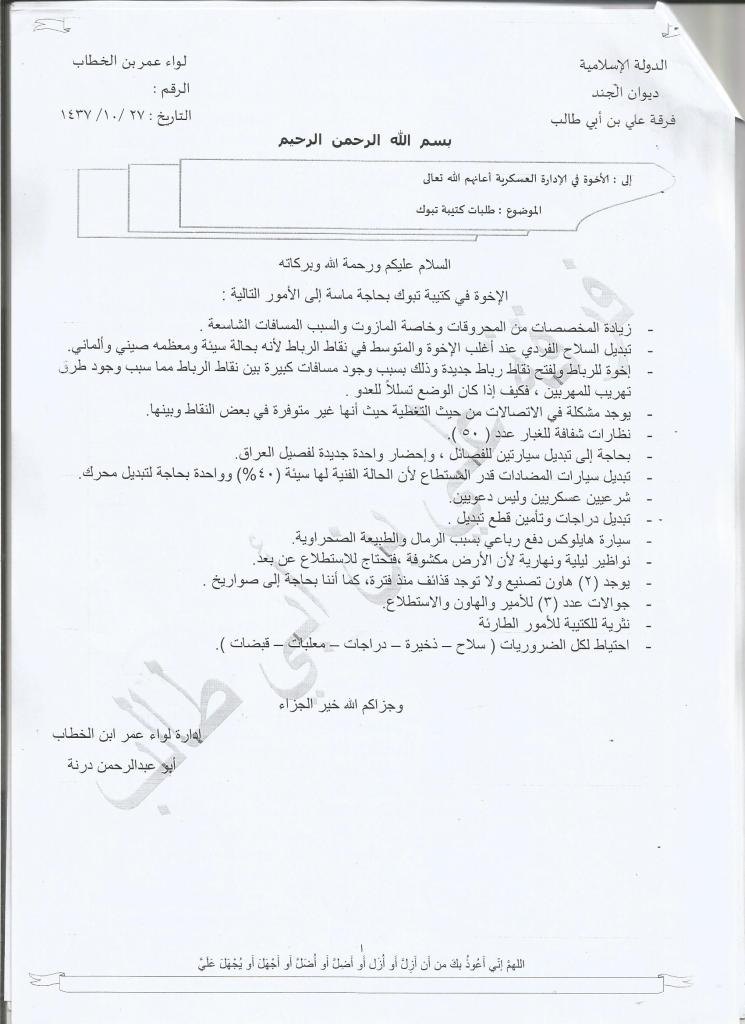
Islamic State Diwan al-Jund Ali bin Abi Talib Division
Omar bin al-Khattab Brigade No. Date: 27 Shawwal 1437 [1 August 2016]
In the name of God, the Compassionate, the Merciful
To: the brothers in the military administration (may God Almighty help them) Subject: requests of the Tabuk Battalion
As-salam alaykum wa rahmat Allah wa barakatuhu
The brothers in the Tabuk Battalion are in urgent need of the following things:
– Increasing the allotments of fuels, especially mazut. This is because of the wide distances.
– Replacing individual weapons among most of the brothers as well as the medium ones on the ribat points, because they are in a bad state, and most of them are Chinese and German.
– Brothers for ribat and to open new ribat points, because there are great distances between the ribat points, which has given rise to smuggling routes for smugglers. So just imagine what it is like then for the enemy to penetrate.
– There is a problem with connections in terms of coverage as it is not present on some points and between them.
– 50 goggles for dust.
– In need of replacing two cars for the companies, and bringing a new one for the Iraq company.
– Replacing the anti-aircraft [?] cars as far as possible, because their technical state is bad (40%) and one is in need of replacing its engines.
– Shari’i military officials and not da’wa officials.
– Replacing the motorbikes and securing spare parts.
– Hilux car because of the sand and desert environment.
– Night and day vision binoculars because the land is exposed, so there is a need for reconnaissance at a distance.
– There are two mortar cannons and there have been no projectiles for some time. We also need rockets.
– Three phones for the amir, mortar and reconnaissance.
– Cash for the battalion for emergency matters.
– Reserve stock for all necessities (arms, ammunition, motorbikes, canned goods and walkie-talkies).
May God reward you best.
Administration of the Omar bin al-Khattab Brigade Abu Abd al-Rahman Derna
“Oh God, I take refuge in You lest I should err or cause to err, or go astray or cause to astray, or be ignorant or for ignorance to be brought upon me.”
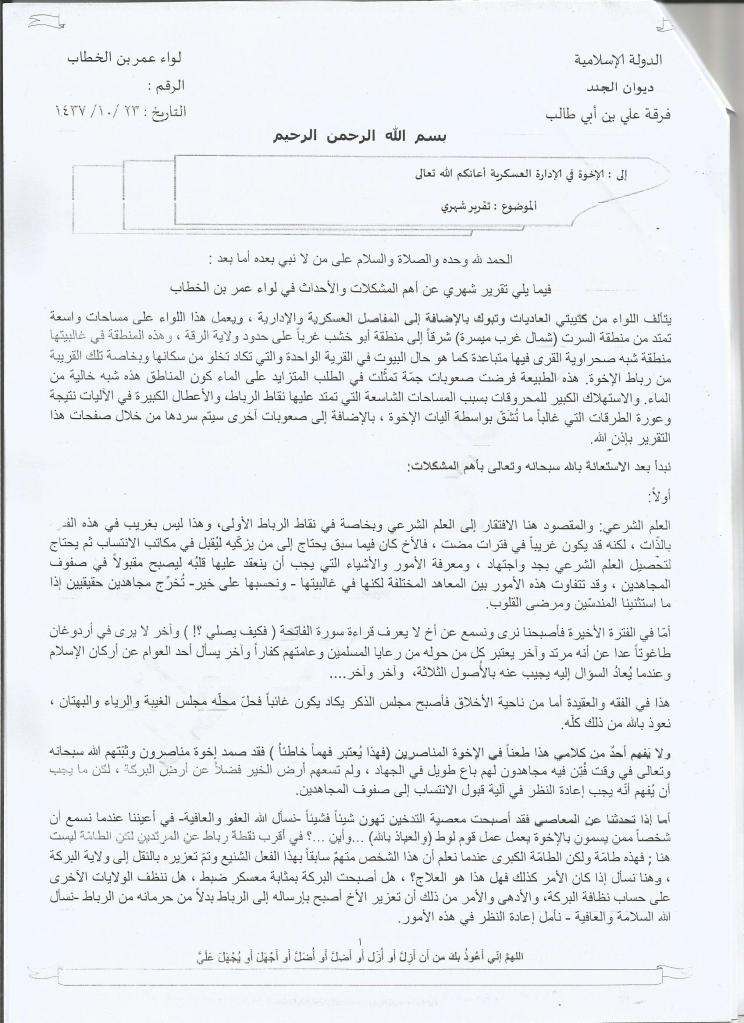
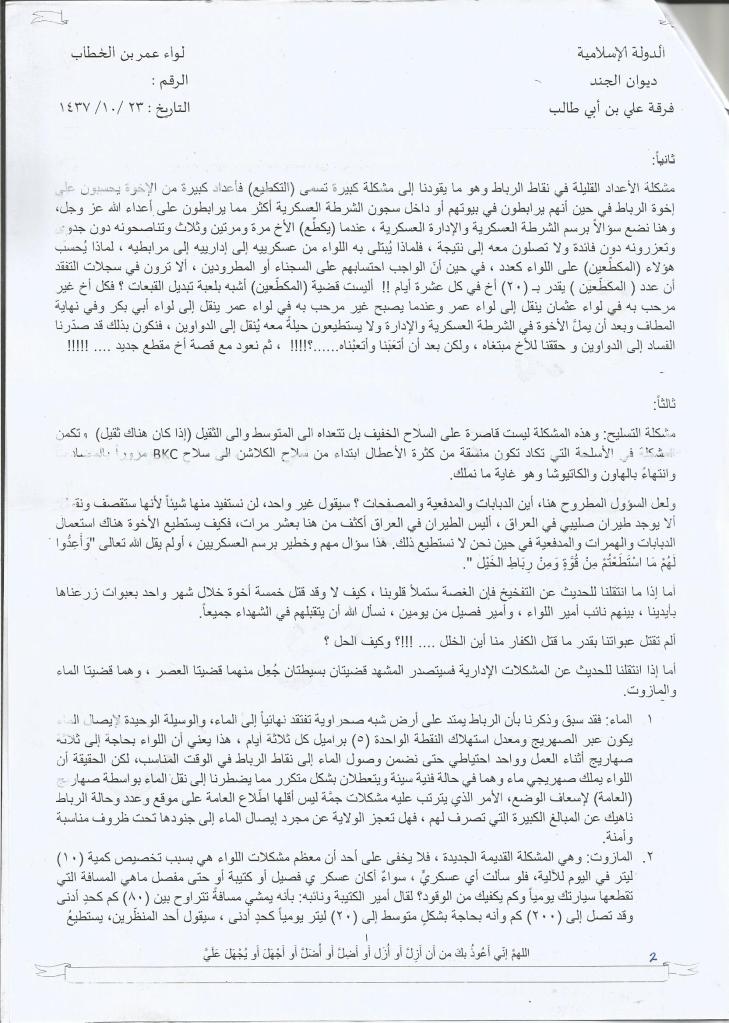
Islamic State Diwan al-Jund Ali bin Abi Talib Division
Omar bin al-Khattab Brigade No. Date: 23 Shawwal 1437 AH [28 July 2016]
In the name of God, the Compassionate, the Merciful
To: the brothers in the military administration (may God Almighty help you) Subject: monthly report
Praise be to God alone and prayers and peace be upon the one after whom there is no prophet. As for what follows:
The following is a monthly report about the most important problems and events in the Omar bin al-Khattab Brigade
1The brigade is composed of two battalions- al-‘Adiyat and Tabuk- in addition to the military and administrative sectors. This brigade operates over a wide area stretching from the al-Sirte area (northwest Maysara) in the east up to Abu Khashab in the west on the borders of Wilayat al-Raqqa. This area is mostly a quasi-desert region with the villages in it being far apart from each other. This is also the case for the homes in one village that is almost devoid of its inhabitants, particularly those near the ribat of the brothers. This natural environment has imposed ample difficulties embodied in the growing demand for water as these areas are almost devoid of water, the great consumption of fuels because of the large areas over which the ribat points stretch, and the great deficiencies in the vehicles as a result of the rugged roads that are likely split by the brothers’ vehicles. In addition, there are other difficulties that will be explained in the pages of this report, by the permission of God Almighty.
We begin, after seeking help in God the Exalted and Almighty, with the most important problems.
1. Shari’i knowledge: meaning lack of Shari’i knowledge, particularly in the first ribat points. This is not surprising at this particular time, but it may be strange in relation to past periods. For the brother previously needed someone to give him tazkiya so he could be accepted in the recruit office. Then he would need to attain Shari’i knowledge with earnestness and effort, and get to know of matters and things that his heart must be convinced of so as to be accepted in the ranks of the mujahidin. These matters may differ between various institutions, but for the most part (and we think well of them) they have brought out true mujahidin, if we exclude intruders and those with disease in their hearts.
As for recently, we have begun to see and hear about the brother who does not know how to recite Surat al-Fatiha (so how can he pray?!) and another who does not see Erdogan as a Taghut let alone an apostate, and another who considers all the Muslim citizens and masses around him to be disbelievers, and still another who asks a member of the masses about the pillars of Islam and when the question is put back to the brother he replies to it with the three principles, and so on and so forth.
This is the case with regards to jurisprudence and doctrine. As for ethics, the council of remembrance of God has become almost absent, with its place being taken by the council of absence, showing-off and slander.
No one should understand from these words of mine that I am attacking the munasirin [supporting] brothers (this is a misunderstanding). For munasirin brothers have been steadfast, and God the Exalted and Almighty has made them steadfast at a time when mujahidin who have am long history of jihad have been tested, and the land of al-Khayr, let alone the land of al-Baraka, has not been able to accommodate them. What must be understood is that there must be a review of the procedure for accepting recruitment into the ranks of the mujahidin.
If we are to speak about acts of disobedience, the act of disobedience in smoking is gradually becoming less significant (we ask God for forgiveness and sufficiency) when we hear that a person among the so-called brothers engages in the acts of the people of Lot (and refuge is to be sought in God). And where? At the point of ribat nearest to the apostates. But the calamity is not here. This is a calamity, to be sure, but the greater calamity is when we know that this person has previously been accused of this ugly action and has been reprimanded by being transferred to Wilayat al-Baraka! And here we ask: if the matter is such, is this the solution? Has al-Baraka become tantamount to a disciplinary camp? Are the other wilayas being cleaned out at the expense of the cleanliness of al-Baraka? The worse and more bitter than this is that the reprimand of the brother took the form of sending him to ribat instead of preventing him from doing ribat. We ask God for safety and sufficiency. We hope for review of these matters.
2. The problem of small numbers at ribat points, which leads us to a great problem called takti’ [abandoning of work duties], for great numbers of the brothers are reckoned to be among the brothers of ribat, performing ribat in their houses or inside the military police prisons more than they perform ribat against the enemies of God (Almighty and Exalted is He). And here we place a question intended for the military police and military administration. When the brother engages in takti’ once, twice and three times, and you advise him without success, and you reprimand him without benefit, and you reach no result. Why should the brigade, from its military officials to administrators and performers of ribat, be tested by that person? Why should these people who engage in takti‘ be affiliated with the brigade in number, at a time when the obligation is to reckon them among the prisoners or expelled people. Do you not see in the inspection records that the number of people who engage in takti’ is estimated at 20 brothers every 10 days!! Is not the issue of people who engage in takti’ like a game of swapping hats? Every brother unwelcome in the Othman Brigade is moved to the Omar Brigade, and when he becomes unwelcome in the Omar Brigade, he is moved to the Abu Bakr Brigade and in the end, after the brothers in the military police and administration get fed up of him and cannot find a way to deal with him, he is transferred to the diwans. Thus we will have exported the corruption to the diwans and we have realised the brother’s desire for him, but after he has exhausted us and we have exhausted him??!!! Then we return with the story of a new brother engaging in takti’!!!!
3. Problem of arming: this problem is not limited to light arms but rather extends to medium and heavy weapons (if there are heavy weapons). The problem lies in the weapons that are hardly organised because of the numerous faults, beginning with the Kalashnikov rifle to PKC weapons and then passing through to anti-aircraft [?] weapons and finally mortars and Katyusha rockets, and this is the most we have.
Perhaps the question to be asked here: where are the tanks, artillery and armored vehicles? Someone else will say: we will have no use at all for them because they will be bombed and we will be killed [?- unclear because of wear to the document]. Is there not Crusader aircraft in Iraq? Is not the aircraft in Iraq ten times more intense than here? So how can the brothers there use tanks, Hummers and artillery while we cannot do so? This is an important and serious question intended for the military officials, or did God Almighty not say: “And prepare for them what you can from force and tying of horses”?
As for if we move on to talking about explosive rigging, the agony will fill our hearts. How can it be otherwise when five brothers were killed in one month by explosives we planted with our hands? Among them was the deputy amir of the brigade, the amir of a company two days ago. We ask God to accept all of them as martyrs.
Surely our explosives have killed as many of us as the disbelievers have? Where is the problem?! And how can it be resolved?
As for if we move to talking about administrative problems, the scene will be headed by two simple issues that have been made the issues of our time. They are the issues of water and mazut fuel.
i) Water: we have previously mentioned that the ribat extends over a quasi-desert area completely lacking in water. The only way to deliver water is via tankers and the rate of consumption of one point is five barrels of water every three days. This means that the brigade needs three tankers during work and one in reserve so we can guarantee that the water will reach the ribat points at the appropriate time, but the fact is that the brigade possesses two water tankers and they are in a bad technical state and they repeatedly experience fault, which forces us to transport water via tankers of the general public to relieve the situation. This entails ample problems, not the least of which is that the general public have review of the position, number of personnel and state of ribat, not to mention the huge sums that are paid to them. Is the wilaya unable to merely delivery water to its soldiers under appropriate and safe circumstances?
ii) Mazut: it is the new old problem. It is not hidden to anyone that most of the problems of the brigade are due to the specifying of 10 litres per day for the machinery. If you were to ask any military official, whether military official of a company or battalion or even sector: what is the distance that your car travels per day and how much fuel suffices for you? The amir of the battalion and his deputy would say: that he traverses a distance ranging between 80km and 200 km, and on average he needs 20 litres each day at a minimum.
One of the theoreticians will say: he can perform ribat and review the circumstances of those performing ribat, and then return to his base and put his hand on his cheek and sit. He is not required to resolve the problems of the brothers, or coordinate with the heavy weaponry department if there is enemy activity, or coordinate with his direct amir, or follow up the affairs of the points of ribat constantly, or repair his vehicle if it experiences faulty, especially if the fault is simple…
As for the brigade administration’s sole vehicle, it is required to go daily from Ruwayshad (the administration’s base) to al-Sur in order to follow up on the affairs of the brothers on leave permit, those returning or those referred, and to follow up the affairs of personnel registration and financial management with the military administration. The administration and the one responsible for it is required to directly follow up the matters in the battalions as the military official brothers desire. This is all on 10 litres per day. Someone will assert (and it may be true) that the policy is applied in Wilayat al-Khayr and affairs are good. We will say to that person that the sector of one brigade in al-Khayr like al-Hawija or al-Jabal is equivalent to the sector of one battalion in al-Baraka in terms of area, and it may be less (and the words here are those of the brother Abu ‘Abd al-‘Aziz Quriya who worked in al-Khayr for the past three years).
As for if we want to speak about the solution and we have been told that these apportionments are limited by a higher committee, we say: let them fear God for themselves and come here, ride our vehicles, measure our distances, observe the nature of our terrain, and then set the quantity of 10 litres per day, because the picture being transmitted to them is not like the actual reality. For by God they will all be held accountable before God the Exalted and Almighty. The Messenger of God (SAWS) said: “Each of you is a shepherd, and each of you is responsible for his flock.”
iii) Problem of vehicles: one need not speak long about the issue of cars. If we know that in the al-‘Adiyat battalion there are two good cars and another broken down, and another whose engine is replaced twice during one month (al-Halfawiya), then as is said: “What is written can be read from its title.” Likewise is the situation in the brigade’s administration that only possesses one vehicle through which it administers the brigade’s affairs. So if the car for food or purchases experiences a fault, then the administration’s car directly takes its place, and so the administration ends up without a car.
In simple comparison with the reality in the second brigade (Abu Bakr) and not in the other wilayas, we will find a great difference in the number of cars, which raises queries!!!
iv) The problem of motorcycles: in al-‘Adiyat this problem is still present, in that the number of motorcycles is counted at 18, most of them in poor technical state. Arrangements were made for four motorcycles, and they have not received a replacement for these four motorcycles. As for in Tabuk, a good motorcycle mechanic is needed and spare parts need to be provided for matters to be good there.
v) Regarding connections, the brigade suffers from a lack of walkie-talkies, and especially for the water tankers and kitchen. There are also no spare walkie-talkies in the event that one of the walkie-talkies on ribat has a fault (not to mention walkie-talkies for expeditions). Also there is a deficiency in chargers for the walkie-talkies because most of them have broken down on the points of ribat as a result of faulty delivery. So we hope that a good quantity of these chargers can be secured.
vi) The ribat points need day-vision and night-vision binoculars. Note the brothers on ribat have none. We also need goggles to deal with dust for the brothers when they are on duty. We have asked for them from the military administration more than once and our request has not been answered.
In conclusion, if I have got things above right, then it is because of God the Exalted and Almighty, and if I have erred, it is because of me and Satan. Have I not conveyed? Oh God, bear witness.
And may God reward you best.
Administration of the Omar bin al-Khattab Brigade Abu al-Harith al-Shami
[At the bottom of each page]:
“Oh God, I take refuge in You lest I should err or cause to err, or go astray or cause to astray, or be ignorant or for ignorance to be brought upon me.”



 The Islamic State Archives