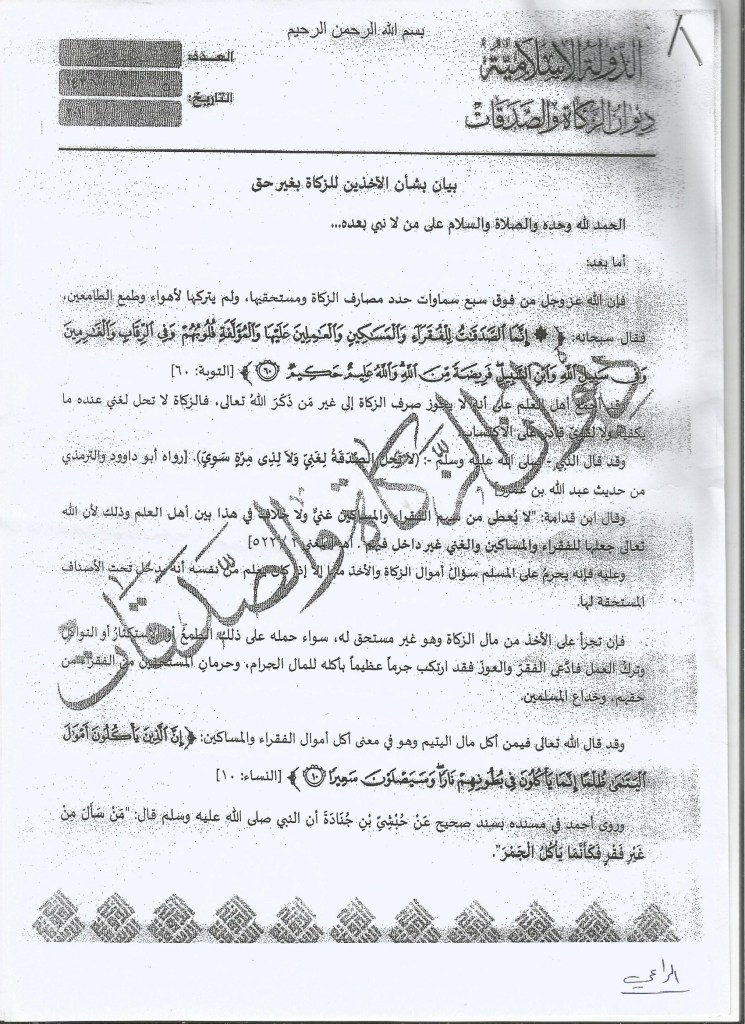
Islamic State
Diwan al-Zakat wa al-Sadaqat
No.
Date: 5 Sha’aban 1437 AH [12 May 2016 CE]
In the name of God, the Compassionate, the Merciful
Statement about those who unjustly take zakat
Praise be to God alone and prayers and peace be upon the one after whom there is no prophet. As for what follows:
From above the seven heavens, God- Almighty and Exalted is He- defined the disbursements of zakat and the people deserving zakat, and He did not leave zakat to the whims and ambitions of the greedy. For the Exalted said: “Charity is for the fuqara’, the masakin, those who work on the matters of charity, for those whose hearts are to be conciliated, for freeing slaves, those in debt, in the path of God, and for the wayfarer. It is a duty imposed by God, and God is wise and knowing” (al-Tawba 60).
The scholars have agreed that it is not allowed to disburse zakat to those who are not mentioned by God Almighty. So zakat is not permitted to a rich person who has sufficient means or to a strong person capable of making a living.
The Prophet (SAWS) said: “Charity is not permitted to a rich or strong person”- (narrated by Abu Dawud and al-Tirmidhi from a hadith of Abdullah bin ‘Amro).
Ibn Qudama said: “A rich person is not to be given from the shares of the fuqara’ and masakin, and there is no disagreement about this among scholars. For God Almighty has made zakat for the fuqara’ and masakin and the rich person is not part of those categories of people” (al-Mughni 2/522).
Therefore, it is forbidden for the Muslim to ask for zakat money and take from it unless he knows from himself that he comes under the categories of people entitled to it.
So if one not entitled to zakat money dares to take from it, whether driven to do so by greed, a desire for more, indifference or abandoning work, and then claims poverty and destitution, that person commits a great crime by consuming wealth forbidden to him, and depriving the entitled ones among the poor of their right, and deceiving the Muslims.
God Almighty has said about those who consume the orphan’s wealth, meaning the consumption of the wealth of the fuqara’ and masakin: “Those who consume the wealth of the orphan in an act of wrongdoing, eat fire in their bellies and will burn in the flames of hell” (al-Nisa’ 10).
Ahmad narrated in his Musnad in an authentic transmission on the authority of Hubshi in Junada: that the Prophet (SAWS) said: “Whoever asks [for zakat] without being poor, it is as though that person is eating fire.”

Muslim narrated on the authority of Abu Hurayra (may God be pleased with him): that the Messenger of God (SAWS) said: “Whoever asks people for their wealth in a bid to gain more is asking for fire, so let him seek less or more.”
“This means that he is punished with Hellfire and it is probably intended in the literal sense, and that what he takes becomes an ember by which he is burned just like the one who refuses to give zakat”- (Sharh al-Nawawi 7/131).
al-Bukhari narrated in the chapter entitled “The one who requests from people in a bid to acquire a lot of wealth” on the authority of Ibn Omar (may God be pleased with them both), that the Prophet (SAWS) said: “The man continues asking the people until he comes on the Day of Judgement and has no piece of flesh on his face.”
Part of the punishment of consuming forbidden wealth is that if one prays, one will not be heard. For Muslim narrated in his Sahih collection on the authority of Abu Hurayra (may God be pleased with him), that the Prophet (SAWS) mentioned the case of the man who travels for a long time and is dishevelled and dusty and raises his hands to heaven and says: ‘Oh Lord, oh Lord.’ But his food and drink come from prohibited things, and his clothing comes from what has been prohibited, and he has been fed with forbidden food. So how can his prayer be answered?
Part of the punishment also is the loss of one’s permissible wealth with one’s forbidden wealth, and that God opens the door of poverty on this person. Ahmad narrated in his Musnad on the authority of Abd al-Rahman bin ‘Awf: that the Messenger of God (SAWS) said: “Man does not open the door of asking for money without God opening the door of poverty upon him.”
So the one who consumes from zakat money without being entitled to it must repent to God (Almighty and Exalted is He), make do with what wealth God has granted him, and return the zakat money he has taken (or its value if he has spent it) to the party from whom he took the money, and be content with what God has provided him. The Messenger of God (SAWS) said: “Successful is the one who has accepted Islam, been provided sufficient sustinence, and has been made content by God with what has come to him”- (narrated by Muslim on the authority of Abdullah bin ‘Amro bin al-‘As). The one who is aware of this person’s state must restrain him, admonish him, and make him afraid of God. If this person repents, that is fine, but otherwise, one must refer said person’s situation to the relevant authority.
Thus, the Diwan al-Zakat wa al-Sadaqat issues a warning to all proven to be consuming zakat wealth while not being entitled to it and having used lying and deception to obtain it, and likewise all those enriched by God following a state of poverty and continuing to take zakat money from the Diwan, that they will come under the list of discretionary punishments put in place by the Diwan, including:
. Imposition of a discretionary punishment on all proven to have lied or concealed their wealth and sufficiency, whereby they must return the zakat money they have taken and a sum ten times its amount, unless they come in repentance before power is gained over them.
We also urge the Muslims to help us to perform this great obligation for which the eyes of those leading its implementation have remained awake for so long so that the zakat can reach those entitled to it, and we urge that the one who knows of a person of sufficient wealth and yet is consuming the wealth of the poor should hurry to inform us via contact with the nearest zakat office. This is an example of cooperation on the basis of piety and fear of God. The Almighty has said: “And cooperate on the basis of piety and fear of God, and do not cooperate on the basis of sin and enmity. And fear God, for God delivers severe punishment”- (al-Ma’ida 2).
And God is well aware of His servants.
Diwan al-Zakat wa al-Sadaqat
The amir
Islamic State
Diwan al-Zakat wa al-Sadaqat
The amir

 The Islamic State Archives